news 1@ulyssesnews.com
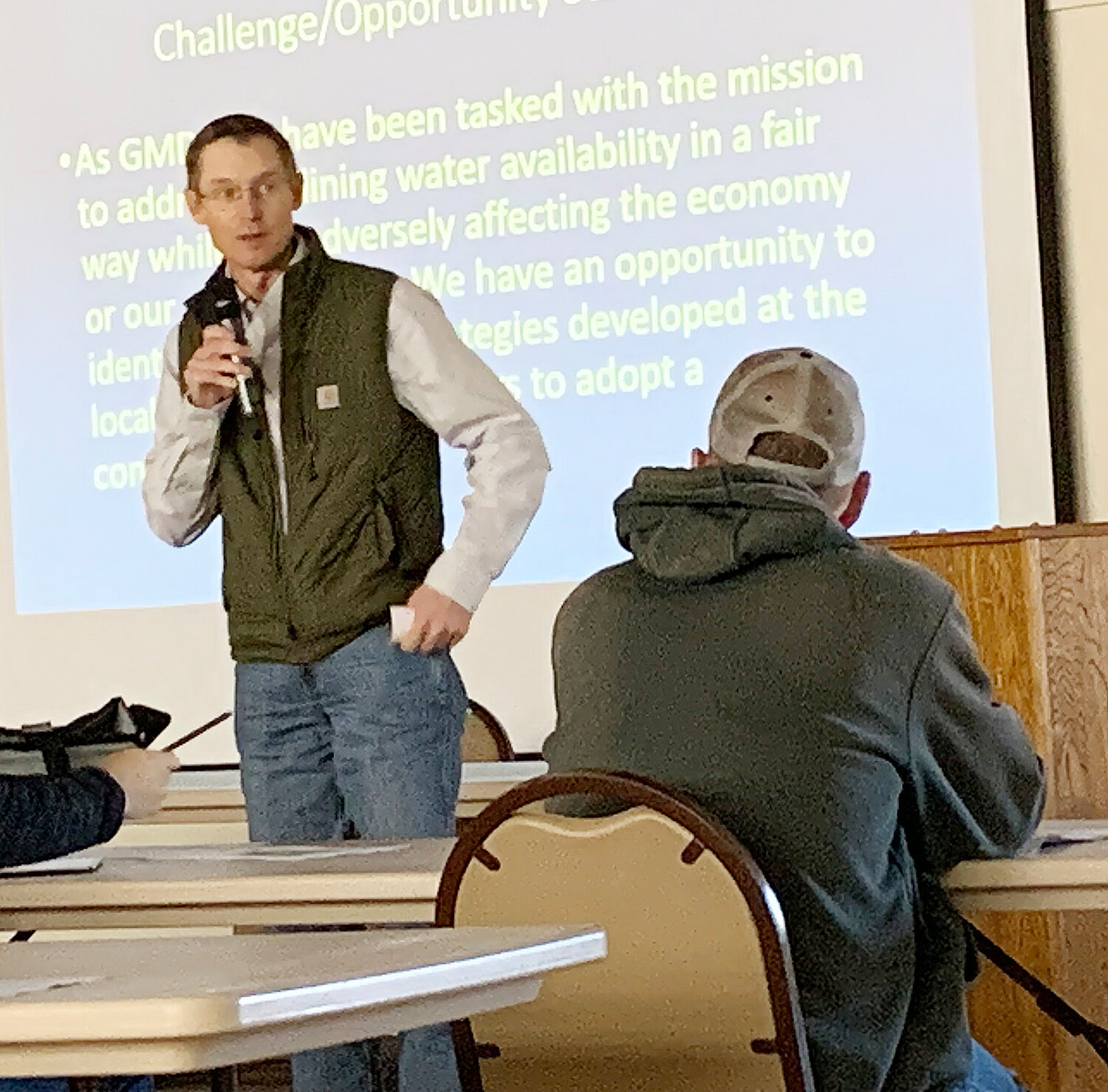
More than 100 area farmers and ranchers met in the South Room of the Grant County Civic Center in Ulysses Nov. 20 for an educational seminar to hear what Groundwater Management District #3’s options are for water conservation to meet state mandates. The district held meetings in Garden City and Dodge City Nov. 19 and held another in Sublette the afternoon of Nov. 20.
GMD has been tasked with the mission to address declining water availability in a fair way while not adversely affecting the economy of the membership. The district says it has an opportunity to identify and choose strategies developed at the local level with stakeholders to adopt a conservation plan.
“Y’all are here today because we all care and we all have passion and we all have purpose here that is to work together and not work against each other,” said GMD 3 General Manager Chad McCormick.
McCormick is the industrial representative for feed yards and dairies for the water district.
“The passion you show for your land, for your farm, for your family and for your community, harness that as you’re thinking about these ideas,” McCormick said. “Because most of it is defensive up front. Most of it is Why? Why are we doing this? What’s happening? But everybody in here that is serious about what they do, makes analytical decisions, they take data and they go in there and they make a decision, whether you’re buying a farm, purchasing equipment, deciding to grow this crop, but these cattle - whatever it is you do - I guarantee you take data and you help make the decision. And that’s all this is today.”
McCormick said the water district board is working on behalf of the local producers.
Water district assistant manager Jason Norquest reiterated McCormick’s statement, saying the board is taking it seriously, how it will affect the economy, individuals and communities.
“Whatever you see here is information, nothing is set in stone, yet,” Norquest said. “That’s why we’re here. We want to hear what you think, what are your ideas? What can we do? What works for you?”
Brett Rooney of Satanta is the Haskell County Representative on the GMD3 board, and said the board has a lot to do. He spoke as a farmer and irrigator whose family has been in the area for generations.
“Southwest Kansas is a major economy, it’s respected around the world and water is the backbone of that,” Rooney said. “We’ve got to make real changes right now, we’ve got to extend the life of this aquifer; it’s never been more important and we’ve talked about it for years.
“We have the chance to do this locally, we have a timeline to get it done locally. If we don’t, someone else is going to come and do it for us and I don’t think anybody in this room is going be able to raise their hand and say they was that.”
The GMD made the first deadline set by the state, which was what is the district’s priorities.
“We have issues all across the district,” Norquest said. “As far as water quality, water quantity, whatever it’s going to be. By doing that, we set it up so now a lot of these programs, you get bumped up if you’re in a priority area.”
Clayton Huseman of the Kansas Livestock Association said these are rights farmers and ranchers own.
“How you see them is based on that right and they’ve got a lot of value, and that’s also why this process is critically important,” Huseman said.
He said in the past years, water conservation was for the greater good, but with no clear definition of the impact that might have.
“Today, with data and information, we have the opportunity to see what it takes to stabilize not only an area, but pretty specific locations within those areas,” Huseman said. “I’ve seen attitudes shift once people can see that ‘Hey, if I make this change, here’s the longterm impact.’”
He added the water largely stays here.
“While it’s all connected, what you do, what an area does to conserve water benefits that area,” Huseman added. “So I’ve seen that change attitudes about making efforts in this area.”
He said there has been an increased issue in the issue from outside the area that want to do something about water conservation.
“There’s a lot of interest from a legislative standpoint to quote ‘Do something,’” Huseman said. “And a lot of that something are things those of you that own those water rights don’t like. And that’s the good thing about going through this process, it keeps the issue very local and in your hands.”
Blake Brownie Wilson with Kansas Geological Survey talked about the tools available and framed some of the resource conditions.
“The first one we talk about is Q-Stable analysis,” Wilson said. “And what this is just a simple approach that we look at the relationship between water use and water level change.”
Q-Stable is the quantity of water that can be pumped from a region that will balance out with recharge and sub-surface inflow, so the water table will be stable.
He said since 2014 the Ogallala Aquifer has declined by one foot with 1.6 million acre feet used across the entire district. He said the Haskell-Seward-Grant County Diagonal 27.7 percent above Q-Stable and the Grant County Sliver, which sits below Ulysses, is 16.2 percent above Q-Stable. The Southern Stevens and Southern Seward County needs is 35.3 percent above and the Chloride area underneath Seward and Meade counties is 34.4 percent above.
The district laid out three scenarios including 100 percent Q-stable - 20 percent every five years; take the number for each region to maintain Q-Stable and cap reduction at 10 percent, or 50 percent reduction of the Q-Stable number.
The attendees broke out into groups to discuss each scenario.
“In each one of those scenarios you can see how the water levels improve because we’re reducing that water usage,” Wilson said. “So we’re not getting to the same level of decline.”
No decisions were made at the meeting, but the district got a good idea of what scenario is most attractive to area producers.




Comments
No comments on this item Please log in to comment by clicking here