news1@ulyssesnews.com
The Cimarron Regional Advisory Committee of the Kansas Water Office held an Online Zoom meeting Sept. 25 to discuss the recent Local Consult meeting Sept. 18 in Dodge City. The committee discussed the results and outlined their responses and what they want to prioritize moving forward.
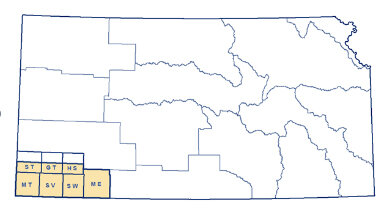
The Cimarron Regional Advisory Committee covers all or part of seven counties in Southwest Kansas, including the southern half of Grant County. The northern half of Grant County is covered by the Upper Arkansas Regional Advisory Committee.
The meeting was part of the water plan implementation process and for the local RAC to give input on what’s most important to them.
“No recommendations have been decided, nothing has been absolutely set in stone in any way,” said Kansas Water Office Director Connie Owen, adding that the Cimarron RAC action steps it’s already listed informs the strategic implementation process. “It folds into it very nicely. There’s a lot of interaction and intersection and overlap and I think you’ll see a lot of your priorities reflected. However there is certainly opportunity about what might be missing, what might you want us to add to recommendations and to considerations for the Water Authority going forward.”
The main issue on the Cimarron RAC’s mind is conserving the High Plains Aquifer and the Kansas Water Office has to prioritize how money is spent. Other issues identified are restoring reservoirs and improving water quality.
Owen discussed potential possible investment scenarios to spend new money that will hopefully get approved by the state. If they’re going to add more money to the state water plan fund and address more water issues, where’s the money going to come from?
For the aquifer, priorities include improving irrigation system efficiency, securing water sources for vulnerable communities, feedlot and stockwater system upgrades, monitoring and modeling, and aquifer management, operations and partnerships.
“Cost effectiveness is a really good way of describing getting the most out of all of the dollars that you spend,” said Cimarron RAC chair Adam Gerrond of Ulysses. “Cost effectiveness and economic impact drive what you end up with from a human standpoint. You’ve got to be able to justify the dollars you spend and you’ve got to be able to predict what that will do to the rest of the economy.”
The main driving factor from the Cimarron RAC’s point of view is the aquifer.
”We’ve got to operate from that point of view,” Gerrond said. “What are we doing to the aquifer and how are we getting bang for our buck in the environment, the gallons that we’re using?”
Southwest Kansas, specifically, is driven by irrigation.
“And all of that builds back into the communities that we have,” Gerrond said. “This place looked an awful lot different in the 1940s and 50s before everybody started drilling wells. Everything that we do and all of our contributions to not just our local area but to the state, bottom line, both economically and culturally, we have to look at it from an irrigator point of view.”
Cimarron RAC board member Gary Boldt of Ulysses said he’s been leaning more to improving the effectiveness of the area’s irrigation techniques.
“It seems to me we should also be working on trying to improve plant effectiveness,” Boldt said. “That is, putting more emphasis on trying to find more drought-resistant crops and other crop qualities that won’t require as much irrigation water.”
Gerrond pointed out that of the three issues identified - Aquifer, Reservoir, Water Quality - the aquifer shows a 38% increase in state funding while reservoirs show an increase in funding of 409% and water quality 186%.
“I know we’re still looking for how to get this money,” Gerrond said. “There’s a very large discrepancy and I understand that some of that is infrastructure and infrastructure is extremely expensive, but I would say that that’s one thing that jumps out at me.”
Gerrond recognized that he didn’t know how many people those three areas affected, “But that’s a fairly stark difference, especially when I know that the High Plains aquifer system accounts for somewhere near 35-38% of the economic impact of the agriculture of Kansas,” Gerrond added. “I feel like that that might be worth exploring.”
Norquest understood Gerund’s point and asked Owen if that would be presented more in the future.
“We’re trying to get input from you on your priorities for the development of recommendations for what money’s going to get spent,” Owen said.
The Kansas Water Office took the input provided during the meeting and will present it at a later time.




Comments
No comments on this item Please log in to comment by clicking here